

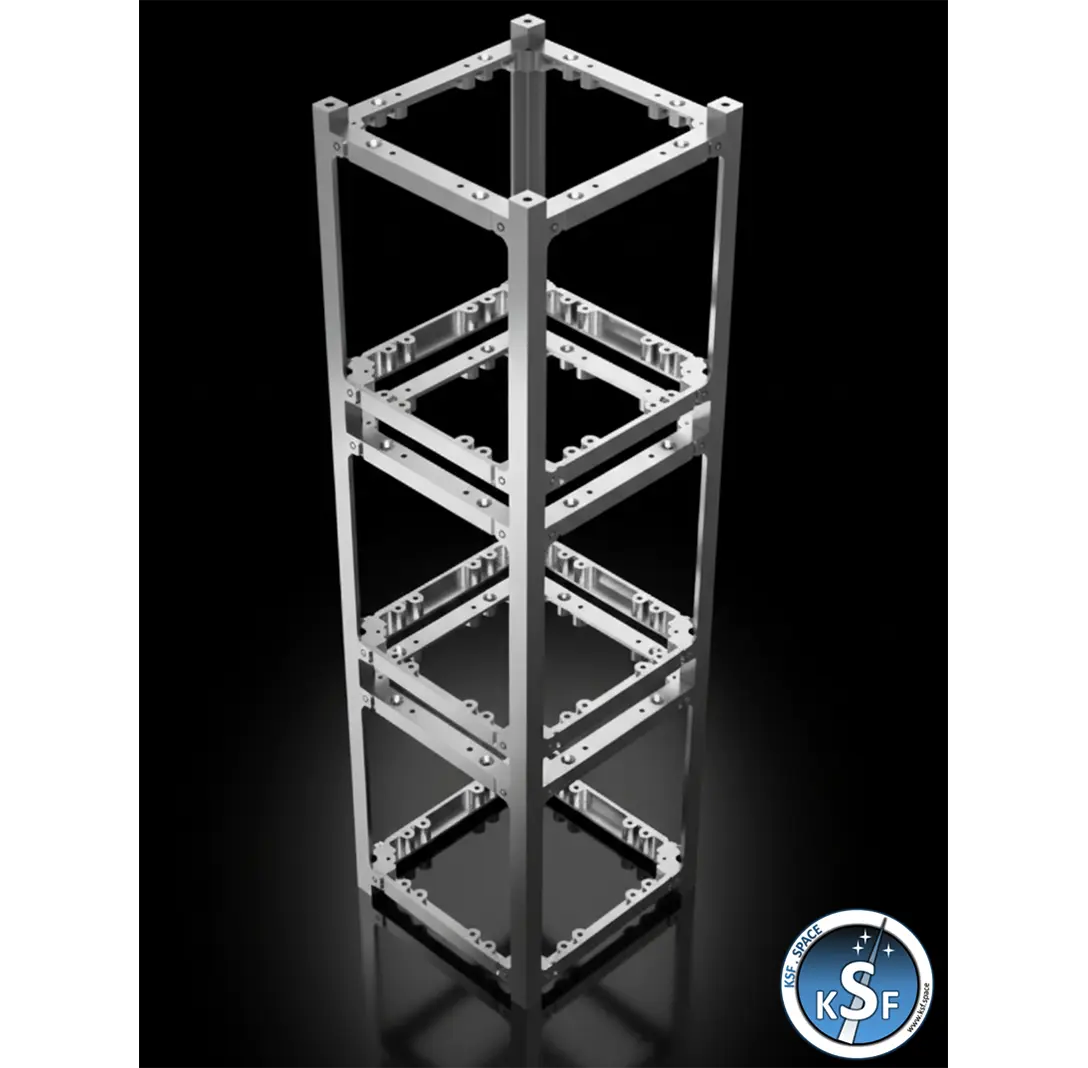
In the competitive landscape of the New Space industry, the 3U CubeSat structure remains the most sought-after configuration for advanced orbital missions. While composite materials are gaining traction, aerospace-grade aluminum continues to be the “Gold Standard” for serious satellite developers.
The KSF Space Foundation has redefined the market by providing a professional, CNC-machined aluminum 3U CubeSat structure through a non-profit model. This initiative ensures that cost is no longer a barrier for universities and research institutions aiming for high-performance Low Earth Orbit (LEO) missions.
Why the Aluminum 3U CubeSat Structure is the Industry Workhorse
For a 3U CubeSat structure, the choice of material is not just about weight—it is about thermal management, structural rigidity, and electrical conductivity. Aluminum alloys, specifically 6061-T6 and 7075, provide a suite of physical properties that polymers cannot yet fully replicate.
KSF Space focuses on these high-grade alloys to offer a frame that acts as a multi-functional component. By using a metallic 3U CubeSat structure, engineers gain a natural “Faraday Cage,” protecting sensitive internal electronics from Electromagnetic Interference (EMI) and harsh solar radiation.
Key Advantages of KSF Space Aluminum Frames
- Superior Heat Dissipation: Aluminum acts as a massive heat sink. In the vacuum of space, where convection is non-existent, the KSF Space structure effectively conducts heat away from high-power components like transmitters and CPUs toward the outer rails.
- Maximum Rigidity: For missions involving Earth Observation (EO) or laser communications, pointing accuracy is vital. The aluminum 3U CubeSat structure from KSF Space minimizes structural flexing, ensuring that sensors remain perfectly aligned during high-G launch phases.
- Hard-Anodized Surface: To meet NASA and ESA deployment standards, KSF Space hard-anodizes all rails. This prevents “cold-welding”—a phenomenon where metals fuse together in a vacuum—guaranteeing a smooth exit from the deployment canister.
Technical Specifications of the KSF Space Aluminum 3U Frame
The KSF Space aluminum 3U CubeSat structure is engineered to be the most reliable and affordable in its class. Below are the technical highlights that make this frame a favorite for 2026 missions:
- Standard Dimensions: $100 times 100 times 340.5$ mm (Fully CDS Compliant).
- Mass Efficiency: Despite its metal construction, the frame is optimized through CNC weight-reduction pockets, keeping the base mass at approximately 245g.
- Material: Aerospace-grade Aluminum 6061-T6 or 7075-T7351.
- Internal Mounting: Full compatibility with the PC-104 stack standard, allowing for seamless integration of COTS (Commercial Off-The-Shelf) boards.
- Flight Heritage: KSF Space structures have been verified through rigorous vibration testing ($10G+$ RMS) and thermal vacuum cycling ($T-VAC$).
Engineering for Success: Integration and Safety
A 3U CubeSat structure is only as good as its ease of assembly. KSF Space has designed their aluminum frames with a “Rapid-Integration” philosophy.
Modular Shear Panels
One of the standout features of the KSF Space design is the use of detachable shear panels. This allows your team to work on the internal “stack” of electronics while the frame is still accessible. Once the avionics are tested, the panels are bolted on, providing the final structural tension needed for flight.
Integrated Safety Features
Every 3U CubeSat structure shipped by KSF Space includes precision-milled slots for:
- Kill Switches: Two redundant switches located on the rails to ensure the satellite remains powered down until deployment.
- Separation Springs: To provide the initial “push” away from the deployer, preventing collisions with the launch vehicle or other satellites.
The Non-Profit Impact on 3U CubeSat Costs
Historically, a flight-qualified aluminum 3U CubeSat structure could cost upwards of $4,000. KSF Space has disrupted this pricing by leveraging its status as a non-profit foundation. By removing the commercial markup, KSF Space enables schools and small startups to access the same hardware used by major space agencies.
When you purchase from KSF Space, you aren’t just buying a frame; you are supporting a global ecosystem that provides NEP (Nanosatellite Engineering Professional) certifications and educational workshops. This holistic approach ensures that your team has both the hardware and the knowledge to succeed.
FAQ: Aluminum 3U CubeSat Structures
Is the aluminum 3U CubeSat structure better than the PA11 version?
It depends on your mission. If your satellite generates significant heat or requires high pointing accuracy for cameras, the aluminum 3U CubeSat structure is superior due to its thermal conductivity and stiffness. For ultra-low-mass missions, the KSF Space PA11 version may be preferred.
Does KSF Space provide the CAD files for integration?
Yes, KSF Space provides STEP files to all mission partners. This allows your engineering team to perform Finite Element Analysis (FEA) and fit-checks within your own 3D environment before the hardware arrives.
What launch vehicles are compatible with this structure?
The KSF Space aluminum 3U CubeSat structure is designed to be “launcher agnostic.” It has successfully met the requirements for SpaceX Falcon 9, Rocket Lab Electron, ISRO PSLV, and various European launchers.
Can the aluminum frame be customized?
Absolutely. KSF Space can provide custom CNC milling for antenna ports, camera apertures, or specialized sensor brackets upon request.
The Foundation of Your Orbital Success
Choosing the right 3U CubeSat structure is the most critical hardware decision in a mission’s lifecycle. By selecting the aluminum frame from KSF Space, you are choosing a material with proven heritage and the most cost-effective pricing in the industry. As we look toward the future of space exploration in 2026 and beyond, KSF Space remains committed to providing the reliable, professional-grade foundations that your vision deserves.
- Official Website: www.ksf.space
- Engineering Support: [email protected]